Home / Make your own cookbook
Most family cookbooks die at step two. Step one is deciding to make one, which feels great. Step two is sitting down with the shoebox and finding that half the cards say "butter, enough," three are in your grandmother's shorthand, and the best recipe in the family was never written down at all.
Twenty to forty recipes is a cookbook. Trying to collect all of them is the thing that stops people.
Getting recipes out of people's heads. Start that first, because it takes weeks of phone calls.
Publishing. A Paprika export of 1,600 recipes lands on RecipeMemoir in a few minutes, free, during our beta.
Written down what it should look like at each step, as well as the amounts. That's the part that never makes the card.
The process
Pick the recipes your family would notice the absence of. The Sunday thing, the birthday cake, the two dishes that show up at every funeral and every wedding. Twenty to forty is plenty, and a short finished book beats a long unfinished one.
Write the list on paper before you touch a computer. It's the only step where being ruthless pays off.
Call the person and ask them to talk you through it while you write. Better, stand in their kitchen while they cook it and note the amounts as they pour, because "a handful" turns into a real number when you watch it land in the bowl.
Ask what it should look like at each stage. Ask what goes wrong. Ask who taught them. Those three answers are the difference between a recipe and a family recipe.
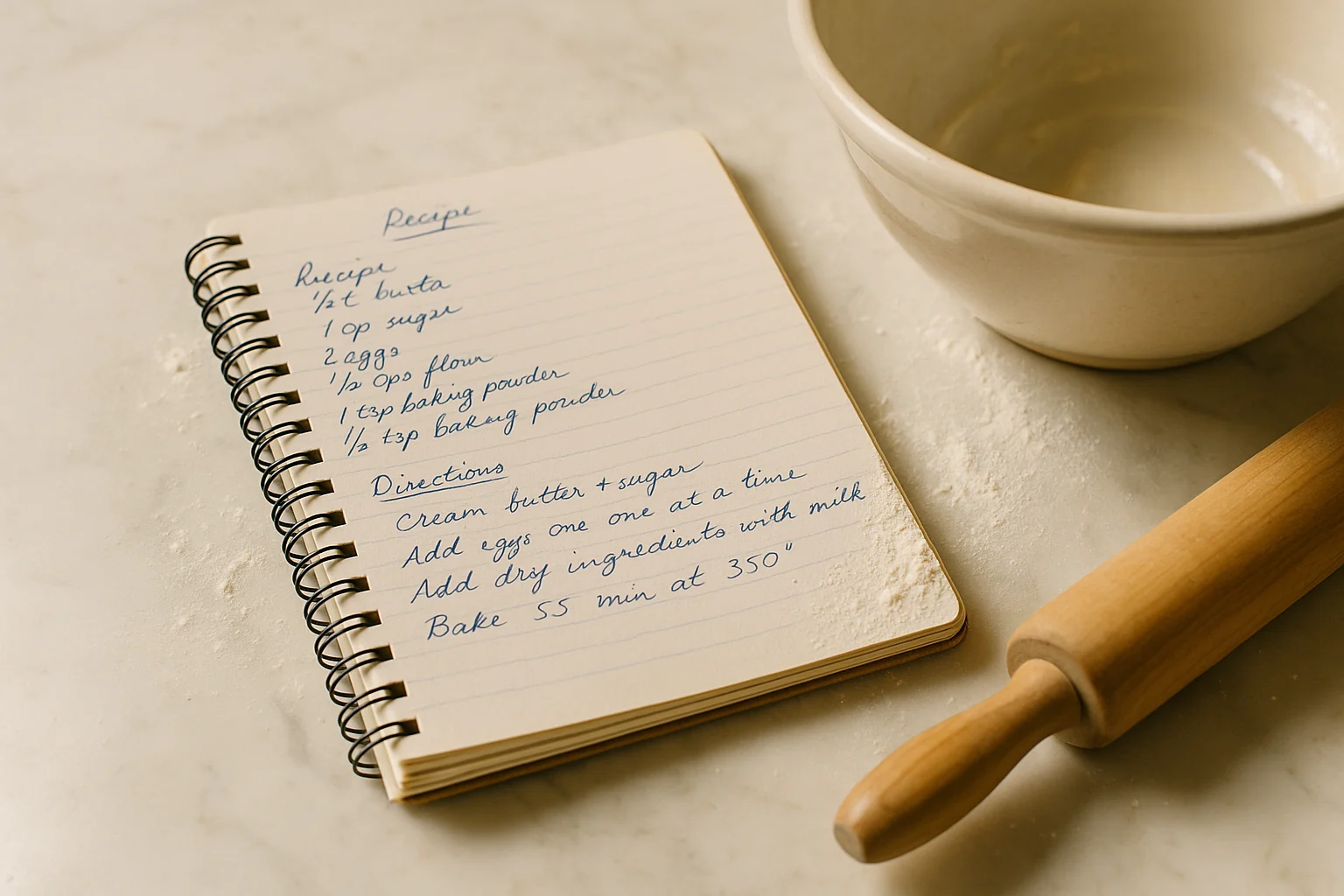
Don't correct them, translate them, and keep both. Put a workable amount in the ingredients ("2 tablespoons butter") and keep the original words in the notes ("butter, enough"). The next cook needs the number. Everyone else came for the voice.
Same for the oven. If the card says "hot oven," write 425°F in the recipe and leave "hot oven" in the note, because someone will want to know how their grandmother thought about heat.
Whatever you use, stop keeping recipes in four systems. On RecipeMemoir there are three doors: drop in a Paprika export file, paste a recipe link from anywhere on the web, or open a blank recipe and type the card in. For the handwritten ones, photograph the card too, so the handwriting sits on the page next to the ingredients.
This is where people lose another two weeks. Choose from a set instead of designing from scratch: RecipeMemoir has 24 styles in six taste families, each previewing with real recipes, and you can switch later without redoing the recipes.
Share the address at twenty recipes rather than waiting for sixty. Two things happen: people start correcting you, which is how you find out your aunt has the real version, and people start sending you recipes you'd forgotten existed.
Publishing
We build one of these, so read the last row with that in mind. The other three are genuinely the right answer for some families, and the failure modes below are the ones we hear about most.
| Approach | What it costs | Good at | Where it falls down |
|---|---|---|---|
| A binder and a photocopier | Whatever the copies cost | Feels like a real object. Works with zero technology. Grandma can hold it. | One copy per person, and every correction means recopying. Nobody ever makes copy number seven for the cousin who married in. |
| A shared document | Free | Everyone already has it. Easy to add to. | Photos fight the formatting, the file gets forwarded and forked, and a document nobody has opened in a year is a document nobody will open again. |
| A photo-book printing service | Priced per copy, and it climbs with page count | A genuinely beautiful physical book, which is the thing many people actually want. | Every fix means a reprint at full price. Check the printer's own current price and its shipping cutoff before you start, because both change every year and the cutoff is real. |
| A recipe website (this) | Free while we're in beta | One address, unlimited readers, corrections in seconds, and photos at a decent size. Every recipe page prints clean on its own. | It's a link rather than an object, and we don't make a printed book yet. If a hardcover on a shelf is the point, use the row above. |
If you use RecipeMemoir
You sign in with your email, no password to invent. You bring recipes in from a Paprika export, from links, or by typing. You pick one of 24 styles. You end up at recipememoir.com/u/yourname with a page for every recipe, a search box, category browsing, and an address you can hand to anyone.
It costs nothing today. RecipeMemoir is in early beta and everything is free, including all the styles, the imports and the AI photo tools. We've published the prices we're considering for later, around four dollars a month for one site and eight for a family plan, and anyone testing with us during the beta stays free for a year.
What it doesn't do: print. A print-ready cookbook export is on the roadmap and isn't built yet, so nothing arrives in the mail. Your whole collection exports as a JSON file free, any time, so nothing you do here traps you.
Pick the recipe you'd be angriest to lose, type it in, and see what the page looks like. That takes about ten minutes and tells you more than another week of planning will.